Gemini 3 Pro Can Now Take Control of Your Computer
For years, the relationship between humans and AI has been defined by a text box. We type a prompt, and the AI types back. It's a powerful paradigm, but an inherently limited one. The AI is trapped inside the chat window, unable to actually do anything with the information it generates outside of that confined space.
On February 3, 2026, Google took a massive swing at breaking down that wall.
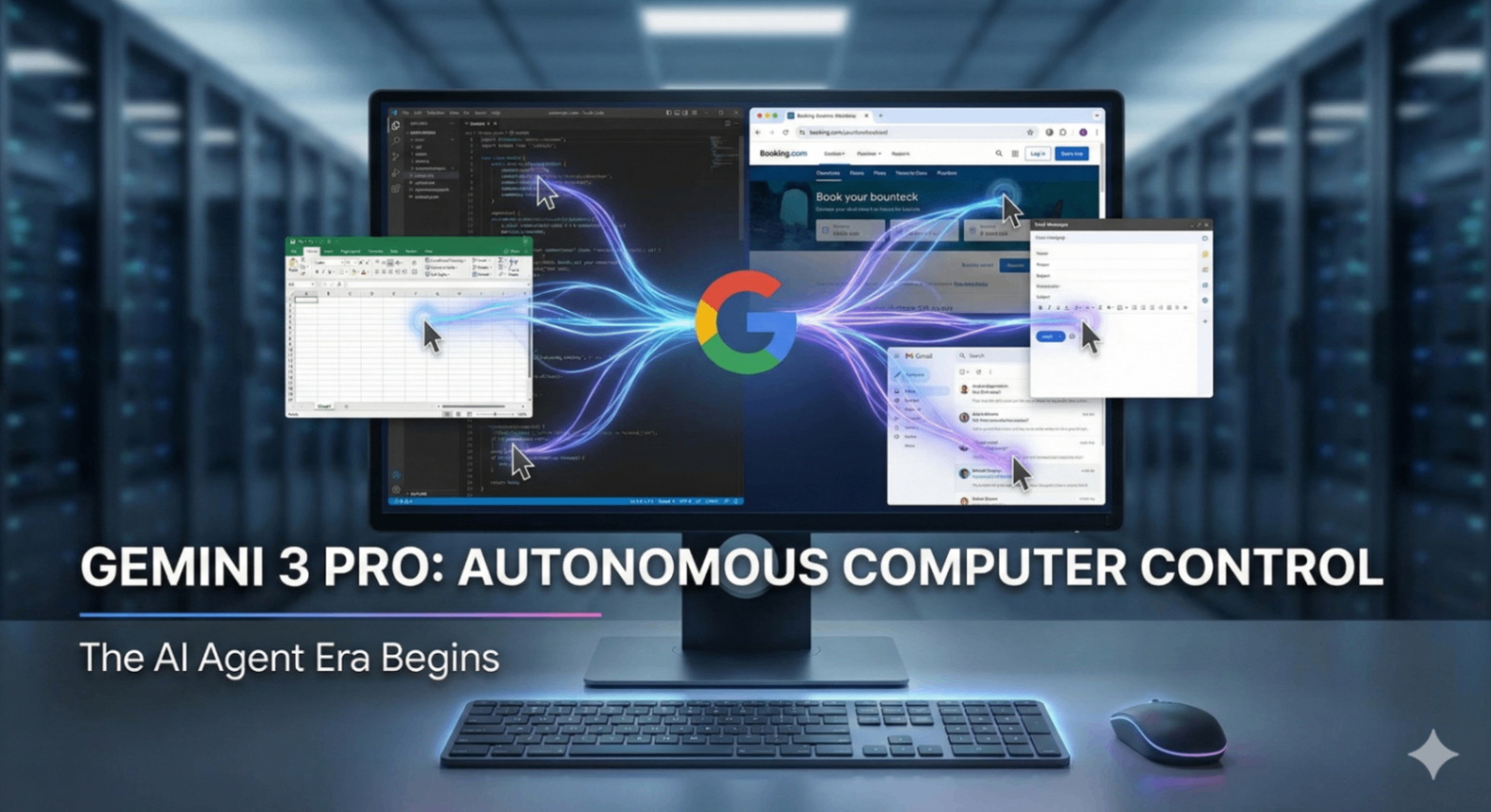
In a quiet but momentous update to its developer changelog, Google announced the launch of a "Computer Use" tool for its bleeding-edge gemini-3-pro-preview model. This isn't just another data processing feature; it's a fundamental shift in capability that allows Gemini to perceive your screen, move the cursor, click buttons, and type text across applications just like a human would.
Here is a deep dive into what this means and why it signals the true arrival of the "AI Agent" era.
Breaking the Fourth Wall: How "Computer Use" Works
Until now, if you asked an AI to "organize my expenses," it might give you a plan or a spreadsheet template. It couldn't actually open your banking app, download the CSV, open Excel, paste the data, and create the pivot table. You still had to be the bridge between the AI's brain and the computer's applications.
The new Computer Use capability changes this dynamic entirely. By giving the gemini-3-pro-preview model direct access to a virtualized screen interface, the AI can:
See: It takes screenshots to understand the visual layout of applications—identifying buttons, text fields, and menus.
Plan: It breaks down a high-level command ("Book a flight for next Tuesday") into a series of low-level actions (Open browser -> Go to travel site -> Click date picker -> Select date).
Act: It programmatically sends mouse clicks and keyboard events to execute the plan in real-time.
From Passive Chatbot to Autonomous AI Agent
This update is the clearest sign yet that the industry is moving aggressively from passive "assistants" to active "agents."
An assistant waits for a specific command and gives a specific answer. An agent is given a goal and autonomously figures out the steps to achieve it across different environments.
Imagine the possibilities for developer and enterprise workflows:
Cross-Application Data Transfer: An agent could monitor an email inbox for invoices (App A), extract the relevant data, log into an accounting portal (App B), fill out the payment form, and then save a confirmation PDF to a shared cloud folder (App C).
Automated QA Testing: Instead of writing brittle Selenium scripts, developers could instruct Gemini to "Go through the user signup flow on our staging site and report any UI errors," letting the AI navigate the interface organically.
Complex Research Compilation: An agent could browse multiple web pages, take screenshots of relevant charts, paste them into a Google Doc, and write a summary analysis below each one.
The Future of Work is Hands-Free
Google's move is a direct challenge to competitors like Anthropic, who have also been exploring similar capabilities. By releasing this to developers now through the gemini-3-pro-preview, Google is looking to accelerate the creation of a new class of applications where the human is the supervisor, not the operator.
While currently in preview for developers, this technology lays the groundwork for a future version of consumer AI—like a supercharged Google Assistant on ChromeOS—that can handle tedious digital chores while you step away from the keyboard completely.